
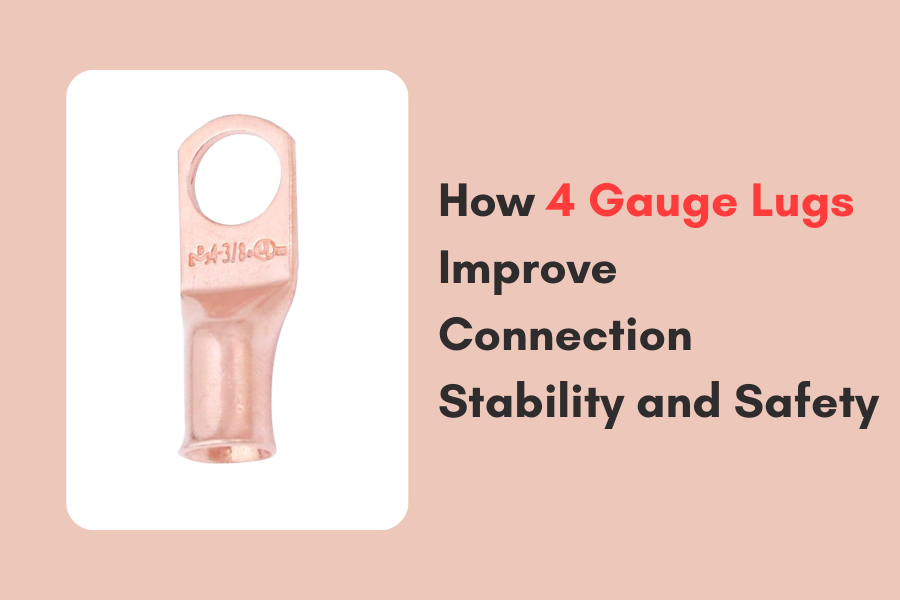
In electrical systems that carry moderate to high current loads, the quality of the cable termination directly affects performance and safety. 4 gauge lugs, also referred to as 4 gauge cable lugs, are widely used to create secure end connections for 4 AWG conductors in automotive, marine, industrial, solar, and battery-based systems. These connectors are designed to provide a stable mechanical hold and efficient electrical conductivity, both of which are essential for safe and reliable operation.
When selected and installed correctly, 4 gauge lugs help reduce the risk of loose connections, overheating, and voltage loss, making them an important component in many real-world applications.
Understanding the Role of 4 Gauge Lugs
A 4 gauge lug is a connector used to terminate a 4 AWG cable to a terminal point such as a battery post, busbar, grounding point, breaker, or equipment terminal. It is typically made from copper or tinned copper to ensure strong conductivity and corrosion resistance.
The lug consists of:
- A barrel section where the conductor is inserted
- A terminal ring or stud hole for fastening
- A compression area where crimping secures the cable
This design helps maintain both mechanical stability and continuous current flow.
How They Improve Connection Stability
Secure Mechanical Grip
One of the main advantages of 4 gauge lugs is their ability to provide a strong grip on the conductor.
When the cable is properly crimped using the correct tool, the barrel compresses around the wire strands to form a firm connection. This prevents cable movement caused by vibration, pulling, or thermal expansion.
This is particularly important in:
- Automotive battery systems
- Marine equipment
- Industrial machinery
- Inverter and UPS connections
A stable mechanical connection reduces the risk of wire loosening over time.
Reduced Vibration-Related Issues
In applications where equipment is exposed to movement or vibration, such as vehicles and heavy machinery, loose terminations can quickly become a safety concern.
A properly installed 4 gauge lug helps maintain contact integrity even under continuous vibration, improving long-term stability.
How They Improve Electrical Safety
Lower Contact Resistance
Electrical safety depends heavily on maintaining low resistance at connection points.
Poorly terminated cables can create resistance hotspots, which may lead to heat buildup and insulation damage. 4 gauge lugs help create a broad metal-to-metal contact area, improving current transfer efficiency.
This helps minimize:
- Voltage drop
- Energy loss
- Heat generation
- Risk of fire from overheated terminals
Prevention of Loose Connections
Loose cable ends are one of the most common causes of electrical faults.
A correctly sized lug ensures the conductor fits tightly within the barrel, reducing the possibility of intermittent contact or arcing.
Arcing can damage terminals and become a serious safety hazard, especially in high-current circuits.
Suitable for High-Load Applications
4 gauge cable lugs are often used in systems that demand stable current transmission.
Common applications include:
- Battery bank connections
- Car audio power systems
- Solar inverter wiring
- Grounding conductors
- Industrial power distribution
In these setups, connector reliability directly impacts system safety and performance.
Importance of Proper Installation
Even the best lug cannot perform effectively without correct installation.
The cable should be stripped cleanly without damaging the strands. A compatible crimping tool must be used to apply the required compression force.
For additional protection, heat shrink tubing is commonly used to insulate the connection and protect it from moisture and mechanical stress.
Conclusion
In high-current electrical systems, 4 gauge cable lugs play an important role in maintaining both connection stability and operational safety. Their ability to provide a secure mechanical hold, reduce resistance, and withstand vibration makes them a reliable choice across various applications.
By selecting the correct 4 gauge lugs and ensuring proper installation, electrical connections can remain safe, durable, and efficient over the long term.